jueves, 20 de marzo de 2014

Metternich and Talleyrand

The two greatest international diplomats of the Napoleonic Era were the Austrian, Klemens von Metternich and the Frenchman, Charles-Maurice de Talleyrand. These two were important people on the Napoleonic Era and there is a really good comparison between them, in this essay I’m going to say the differences and the similarities of Metternich and Talleyrand.

Klemens von Metternich was a politician and statesman of Rhenish extraction and one of the most important diplomats of his era, serving as the Foreign Minister of the Austrian Empire from 1809 until the liberal revolutions of 1848 forced his resignation. Metternich found himself in the difficult position of representing Austria in the face of the overweening threats and
ambitious plans of Napoleon at the height of his power. He did so with dignity and firmness, as his report of his important audience with Napoleon on 15 August, 1808, shows. Soon after, however, he engineered Austria's entry into the War of the Sixth Coalition on the Allied side, signed the Treaty of Fontainebleau that sent Napoleon into exile.


Charles-Maurice de Talleyrand, Prince of Benevento, Bishop of Autun, French minister and ambassador. He worked as foreign minister for the regime of Louis XVI, through several governments of the French Revolution and then for Napoleon. He was Napoleon's chief diplomatic aide. Most of the time, however, he worked for peace so as to consolidate France's gains. He succeeded in obtaining peace with Austria in the 1801 Treaty of Luneville and with Britain in the 1802 Treaty of Amiens. He resigned as foreign minister in August 1807 but Napoleon still trusted him. Talleyrand connived to undermine Napoleon's plans and secretly dealt with Tsar Alexander of Russia and the Austrian minister Metternich. When Napoleon fell, he took charge of the Bourbon restoration based on the principle of legitimacy. He played a major role at the Congress of Vienna, where he negotiated a favorable settlement for France while undoing Napoleon's conquests.

The Differences between Charles-Maurice de Talleyrand and Klemens Von Metternich; there’s no too many differences between these two ministers. Metternich was a minister of the Austrian Empire; Talleyrand was France’s foreign minister. Talleyrand worked for several governments and Metternich only for Napoleon. Napoleon considered more trustable Talleyrand than Metternich. Metternich was forced to resign and Talleyrand do it by his own.

The similarities of these two characters were more that the differences. They both were ministers and worked for Napoleon. Both changed the Austrian Empire. They were really good politicians and both made treaties.

 The present-day obscurity of both Talleyrand and Metternich surprises because they not only influenced their own times, but their political legacy continues to affect the world today. They both were really good politicians, there are differences and similarities between them, but they are really similar.
References:


miércoles, 26 de febrero de 2014

House of Hanover

It was 1714 when a German Prince was crowned King George I of Great Britain, with this, start 

the beginning of a new political era, that saw the rise of the new role of Prime Minister, and 

established the pattern of political modernity that we are familiar with today. When, in 1789, the

 Bastille prison in Paris was stormed and the French Revolution began, few in Britain - least of 

all King George III, who was recovering from one of his bouts of madness - thought that it would 

lead to a cataclysmic war with France.

The Monarchs of the House of Hanover were King George I, King George II, King George 

III, King George IV, King William IV and the Queen Victoria.

Queen Anne, the last of the Stuarts, had 17 pregnancies which resulted in only three live births. 

 In 1700, the last of those three children, Prince William, Duke of Gloucester, died of smallpox 

six days after his eleventh birthday.  Parliament was faced with a succession crisis as it did not 

want the throne to go to a Roman Catholic.  The 1701 Act of Settlement  was passed giving the

 throne to the Electress Sophia of Hanover and her Protestant descendants.


jueves, 20 de febrero de 2014

Massacre de la Saint Barthelemy

(extra credit)
The massacre happened on August, 1572. It was a massacre between protestants and      

catholics. This tragic episode of the wars of
religion is the result of a complex fight of multiple

 factors.There was a lot of reasons and causes for why this happened, like the wedding of the 

king's sister Margaret to the Protestant Henry III of Navarret. This marriage was an occasion for

 which many of the most wealthy and prominent Huguenots had gathered in largely 

Catholic Paris, the assassination of  Gaspard de Coligny, the military and political leader of the

 Huguenots. The king ordered the killing of a group of Huguenot leaders, including Coligny, and

 the slaughter spread throughout Paris. Lasting several weeks, the massacre expanded 

outward to other urban centres and the countryside.

A list of those to be killed was drawn up, headed by Coligny, who was brutally beaten and 

thrown out of his bedroom window just before dawn on August 24. Once the killing started, 

mobs of Catholic Parisians, apparently overcome with bloodlust, began a general massacre of 

Huguenots. The massacre also marked a turning point in the French Wars of Religion.

miércoles, 5 de febrero de 2014

"January 28, 1986"/ GALAXIES

This song is by Owl City, this  is comformed  by Adam Young. Owl City is one of Young's many solo projects, with all music written, composed, recorded, and produced by him. During live performances he is accompanied by a group of supporting musicians. He plays synthpop and electronic music. Young created the project while experimenting with music in his parents' basement. 

Adam Young created this song, because he was curious about the Space Shuttler Challenger Disaster, which happen in January 28, 1986. 

Adam Young, the mastermind behind Owl City, has this to say about the curious "January 28, 1986": 

"There's a track on the new record called January 28, 1986 and it features a clip from Reagan when the space shuttle Challenger blew up that same year and it's kind of a sobering... piece, and it stuck me. I was actually born that same year, '86, my parents always used to talk about it and so it was always on my mind growing up and I felt like it would be a good thing, to pay dues to that, and I've just out of respect feature a little interlude on the record, that Reagan quote, and the idea behind it is that it's kind of a precursor to the following track on the record called Galaxies, just to kind of set up the premise of the following song and it's just a short little interlude and it was a fun thing to do. I'm glad it came together."

The Space Shuttler Challenger Disaster ocurred when  Space Shuttle Challenger (mission STS-51-L) broke apart 73 seconds into its flight, leading to the deaths of its seven crew members. The spacecraft disintegrated over the Atlantic Ocean, off the coast of Cape CanaveralFlorida. Disintegration of the vehicle began after an O-ring seal in its right solid rocket booster (SRB) failed at liftoff. The O-ring failure caused a breach in the SRB joint it sealed, allowing pressurized hot gas from within the solid rocket motor to reach the outside and impinge upon the adjacent SRB attachment hardware and external fuel tank. This led to the separation of the right-hand SRB's aft attachment and the structural failure of the external tank.Aerodynamic forces broke up the orbiter. As a result of the disaster, the Air Force decided to cancel its plans to use the Shuttle for classified military satellite launches from Vandenberg Air Force Base in California, deciding to use the Titan IV instead.

Here is a video that includes the lyrics and the audio of the song:
Hope you like it!


I really like this song, because i didn't know about this disaster, and know i have a lot of information of it, i really do a lot of research to found an interesting song, i found a lot, but i want one song who give me new information, and this one did it. I found another one also interesting it talks about rapid-fire allusions to more than 100 headline events between January 1949 (Joel was born on May 9 of that year) and 1989, when the song was released on his album Storm Front; it's a good song, it doesn't have like a lot of information, but i like the rythm and the lyrics, it's named "We didn't start the fire" By Billy Joel, if you have time hear it, it is cool. 


martes, 21 de enero de 2014

Witchcraft persecution

In the period of 1500-1750 it was legally sanctioned and involving official witchcraft trials.
People in Switzerland think that witches make pacts with the devil, giving them special powers, they said that they didn't talk to the devil alone, they were always in groups or coven. 

In 17th century colonial North America, the supernatural was part of everyday life, for there was a strong belief that Satan was present and active on Earth. Witchcraft was then used by peasants, who invoked particular charms for farming and agriculture. Over time, the idea of white magic transformed into dark magic and became associated with demons and evil spirits.In 1688, John Putnam claimed that he could prove the existence of witches and ghosts of the supernatural realm. Glanvill wrote about the "denial of the bodily resurrection, and the supernatural spirits". 


Men and women in Salem believed that all the misfortunes were attributed to the work of the devil; when things like infant death, crop failures or friction among the congregation occurred, the supernatural was blamed. Because of the unusual size of the outbreak of witchcraft accusations, various aspects of the historical context of this episode have been considered as specific contributing factors.

Abigail WilliamsBetty ParrisAnn Putnam, Jr., and Elizabeth Hubbard began to have the power of Epileptic Fits or natural disease to effect. This resulted in the deaths of 25 citizens of Salem.

In the 18th century,were the las executions of people convicted as witches. Catherine Repond, was one of the last people to be executed for Sorcery in Switzerland prior to Anna Goldi. Catherine Repond was arrested in April 1731 and taken to a castle in Corbières, where she was interrogated by torture to confess that she had flown on a broomstick to the witche's sabbath. She was then taken to Fribourg, where she was sentenced to death for witchcraft and executed by strangulation and burning. In 1782, Anna Göldi, often called the last witch, was executed, but Göldi's trial was a dubious witch trial, while Repond was openly executed for this accusation.


viernes, 6 de diciembre de 2013

Barbarians-The Mongols

Extra Credit

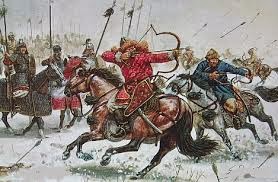
Mongols are Central and Northern Asian (Inner Asia) ethno-linguistic group. Although the largest Mongolic group are those of Mongolia, they also live as minorities across Northern Asia, including RussiaChina, and many of the former Soviet Union states. Mongolic peoples belonging to the Buryat ethnic group live predominantly in what is now the autonomous Republic of Buryatia, Russia. In China, they live mainly either in Inner Mongolia or, less commonly, in Xinjiang. Mongolic peoples are bound together by a common culture and language, a group of related tongues known as Mongolic languages.

The Mongol Empire emerged from the unification of Mongol and Turkic tribes of historical Mongolia under the leadership of Genghis Khan. Genghis Khan was proclaimed ruler of all Mongols in 1206. The empire grew rapidly under his rule and then under the rule of his descendants, who sent invasions in every direction. The area around MongoliaManchuria, and parts of North China had been controlled by the Liao Dynasty since the 10th century.

The empire began to split as a result of wars over succession, as the grandchildren of Genghis Khan disputed whether the royal line should follow from Genghis's son and initial heir Ögedei, or one of his other sons such as ToluiChagatai, or Jochi.

The Battle of Ain Jalut in 1260 marked the high-water point of Mongol conquests, and was the first time a Mongol advance had ever been beaten back in direct combat on the battlefield. Though the Mongols launched many more invasions into Levant, briefly occupying it and raiding as far as Gaza after a decisive victory at the Battle of Wadi al-Khazandar in 1299, they withdrew due to various geopolitical factors.

By the time of Kublai's death in 1294, the Mongol Empire had fractured into four separate khanates or empires, each pursuing its own separate interests and objectives: the Golden Horde khanate in the northwest, the Chagatai Khanate in the west, the Ilkhanate in the southwest, and the Yuan Dynastybased in modern-day Beijing.

King Arthur

Extra credit

King Arthur, is a legendary British leader of the 6th centuries  according to medieval histories and romances, he led the defence of Britain against Saxon invaders in the early 6th century. His historical existence is debated and disputed by modern historians.

The legendary Arthur developed as a figure of international interest largely through the popularity of Geoffrey of Monmouth's fanciful and imaginative 12th-century Historia Regum Britanniae.

Arthur appears either as a great warrior defending Britain from human and supernatural enemies or as a magical figure of folklore, sometimes associated with the Welsh Otherworld.

Although the themes, events and characters of the Arthurian legend varied widely from text to text, and there is no one canonical version, Geoffrey's version of events often served as the starting point for later stories. Geoffrey depicted Arthur as a king of Britain who defeated the Saxons and established an empire over BritainIrelandIceland,Norway and Gaul.